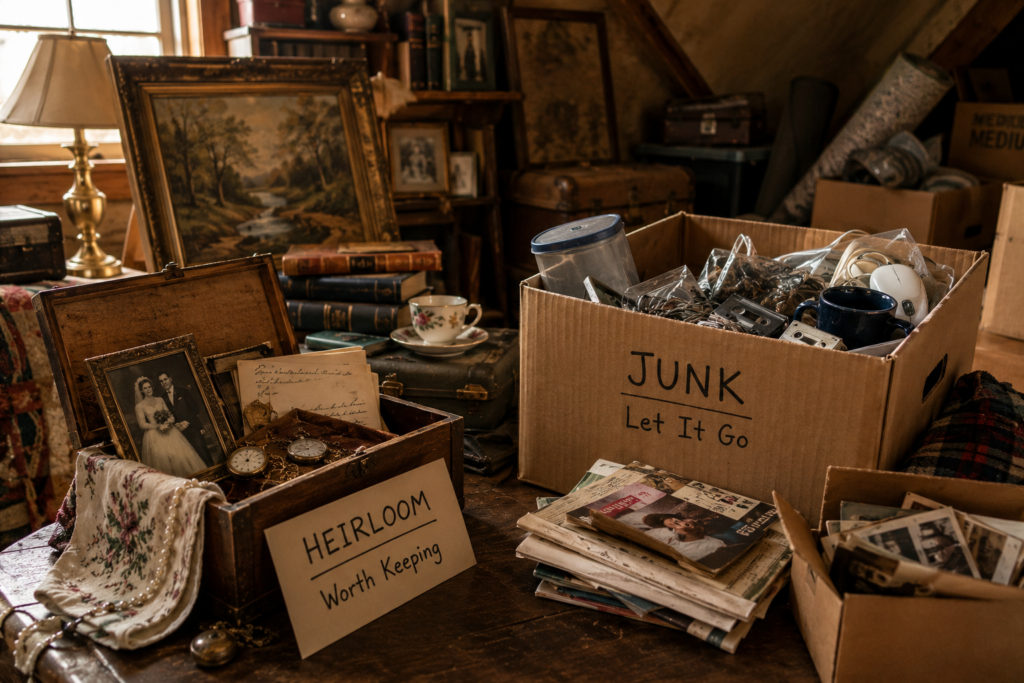
Almost everybody has things they hold onto “just in case.”
Boxes in garages. Old furniture. Containers full of cables, paperwork, decorations, parts, clothes, tools, memorabilia, inherited items, half finished projects, and things that haven’t been touched in years.
Most people don’t think much about it because the buildup happens slowly.
One item becomes ten. Ten become a room. Then eventually entire garages, storage units, sheds, attics, and spare bedrooms become filled with things people barely even notice anymore.
But over time I started realizing something.
A lot of what people call sentimental value is actually avoidance.
Avoidance of letting go.
Avoidance of change.
Avoidance of confronting whether something still belongs in their life.
That realization changes how you look at ownership.
Not Everything Old Is Valuable
People often confuse age with importance.
Just because something survived a long time does not automatically make it meaningful, rare, or worth preserving.
I’ve seen families hold onto massive amounts of furniture, dishes, collectibles, tools, and random household items believing future generations would deeply cherish them one day.
Then eventually reality hits.
The younger generation often doesn’t want most of it.
Not because they’re disrespectful, but because emotional attachment usually does not transfer equally across generations.
What meant everything to one person may mean almost nothing to someone else.
That can be a difficult thing to accept.
Some Things Become Burdens Disguised as Memories
I’ve walked through homes where people were emotionally overwhelmed by the amount of stuff surrounding them.
Entire rooms dedicated to things nobody uses. Storage units costing thousands over time to protect items worth less than the storage bill itself.
Sometimes people are not preserving value anymore.
They’re preserving guilt.
Or identity.
Or fear of regret.
One of the strangest parts of ownership is how easily people adapt to carrying unnecessary weight. Eventually clutter stops looking unusual because they’ve lived around it for so long.
But the weight is still there.
Financially. Emotionally. Mentally.
True Heirlooms Usually Carry Real Meaning
The things that truly survive generations usually have something deeper attached to them.
A story.
A moment.
Craftsmanship.
Historical importance.
Family identity.
Personal significance.
Not just age.
A watch your grandfather wore every day while building his business may carry real emotional value. A handwritten journal may become irreplaceable. A classic car tied to family history may become something future generations genuinely appreciate.
But twenty boxes of random household items from decades ago usually do not become treasured heirlooms simply because time passed.
That distinction matters.
People Often Keep Things for Fantasy Futures
This is more common than people admit.
People keep workout equipment for the version of themselves that will eventually get back into shape. Old project cars for the restoration they swear they’ll start one day. Supplies for hobbies they no longer participate in. Clothes for a lifestyle or body they haven’t had in years.
Sometimes the item is no longer serving the present. It’s serving a fantasy version of the future.
I’ve done this myself.
At one point I realized I was storing certain things not because they added value to my life, but because getting rid of them felt like admitting a chapter of my life had changed.
That’s a very different reason to keep something.
Storage Has a Cost People Ignore
People love calculating the value of what they own while completely ignoring the cost of maintaining it.
Storage costs money.
Maintenance costs money.
Organization costs time.
Moving things costs energy.
Managing clutter costs mental clarity.
Even if something is technically valuable, it still has to justify the resources it consumes.
That’s one reason why some collections quietly become liabilities.
People become caretakers of possessions they no longer truly enjoy.
Collecting With Intention Is Different
This doesn’t mean people should become emotionless minimalists.
Some possessions absolutely enrich life.
The right artwork can inspire you daily. A meaningful car can create unforgettable experiences. Family items with real stories can strengthen identity and connection across generations.
The issue is not ownership itself.
The issue is unconscious ownership.
Keeping things without honestly evaluating whether they still deserve space in your life.
Intentional collectors usually understand exactly why they own what they own.
That awareness creates very different environments from people who simply accumulate endlessly.
Future Generations Will Value Different Things
This is another uncomfortable reality.
Every generation values different categories differently.
Some antiques that were once highly prized have collapsed in value because younger buyers simply do not care about them anymore. Entire furniture categories softened because lifestyles, homes, tastes, and priorities changed.
At the same time, newer categories exploded.
Vintage video games. Sneakers. Watches. Certain Japanese cars. Sports cards. Technology from specific eras.
Cultural relevance changes constantly.
That’s why assuming something will automatically become valuable because it’s old can become a costly mistake.
Demand matters just as much as age.
The Best Things Usually Earn Their Place
The possessions worth keeping long term usually continue proving their value over time.
You use them.
Appreciate them.
Display them proudly.
Talk about them.
Maintain them willingly.
They continue contributing positively to your life instead of quietly draining resources while sitting forgotten.
That’s usually the difference between a meaningful possession and stored clutter.
One continues adding value.
The other mostly consumes it.
Final Thoughts
Not everything deserves to become an heirloom.
Some things truly carry history, meaning, craftsmanship, or emotional significance worth preserving. Others are simply objects we became too emotionally attached to question honestly.
Being selective matters.
Because eventually every possession asks something from you. Space. Time. Money. Attention. Responsibility.
And if something continually takes more value from your life than it brings, it may not really be an heirloom at all. It may just be junk with emotional protection around it.